
MDOC Winston Release Paths
MDOC operates a statewide correctional system that includes prisons, regional-facility placements, Community Corrections, and supervision. A person serving a state sentence at WCCRCF remains an MDOC prisoner even though the building is in Winston County and holds county detainees too. That person may transfer to another MDOC unit, enter parole or Earned Release Supervision, or reach final discharge. Each outcome has a different legal meaning and record trail.
Parole and ERS end physical confinement while state supervision continues. Final discharge ends the relevant MDOC sentence status. A transfer changes location but not custody. The public inmate detail can show a location and tentative release date, while the parolee system can identify an active parole record. Neither is a certified discharge record. For the strongest proof, obtain the discharge certificate or formal response from MDOC Records and check Community Corrections when supervision applies.
A future Tentative Release Date is a projection. It does not confirm that MDOC released or discharged the person.
Search MDOC Winston Records
The MDOC Inmate Search accepts first name, last name, or MDOC ID. The unique ID is the safest key because names and spellings can collide. Open the detail rather than relying on a search-engine snippet. Compare the MDOC number, birth data, physical description, county of conviction, sentence, and current location before deciding that a record belongs to the person sought.
- Search by MDOC ID when available; otherwise try the full name and spelling variants.
- Open the detail and read Location, Location Change Date, sentence fields, and Tentative Release Date separately.
- Run the separate MDOC Parolee Search by name or ID and use Winston as a county filter when suitable.
- For an actual discharge, contact MDOC Records and request the release or discharge record and time computation.
- If the state record points to another hold or authority, continue with that agency rather than calling the event final release.
A no-match does not mean discharge. It may indicate no MDOC commitment, an alternate name, an older or nonpublic record, a data correction, or a record outside the state system. A Winston County conviction label also does not establish WCCRCF as the release facility. Match the sentence and location history. The Winston County released-inmate record path covers the county and court sources needed when no state commitment exists.
MDOC Release Detail Fields
The public MDOC detail format provides more than a single date. It can display identity, photograph, entry and location information, number and total length of sentences, each offense, county of conviction, and a tentative date where applicable. Those fields help reconcile identity and sentence context. They do not replace the agency’s master time sheet or discharge certificate.
| MDOC field | What it supports | Main limit |
|---|---|---|
| MDOC ID | Stable state-system identity | Not a county booking number |
| Location and unit | Reported placement | A location change can be transfer, not release |
| Location Change Date | When the displayed placement changed | Not necessarily physical discharge time |
| Sentence fields | Offense, county, date, and term context | Public view may not show the full computation |
| Tentative Release Date | Current prospective date when displayed | Mutable and not proof of actual release |
| Photograph | MDOC identification image | Not necessarily the Winston booking photo |
The captured MDOC detail example documents the interface label and related state fields. It is not presented as a Winston County release.
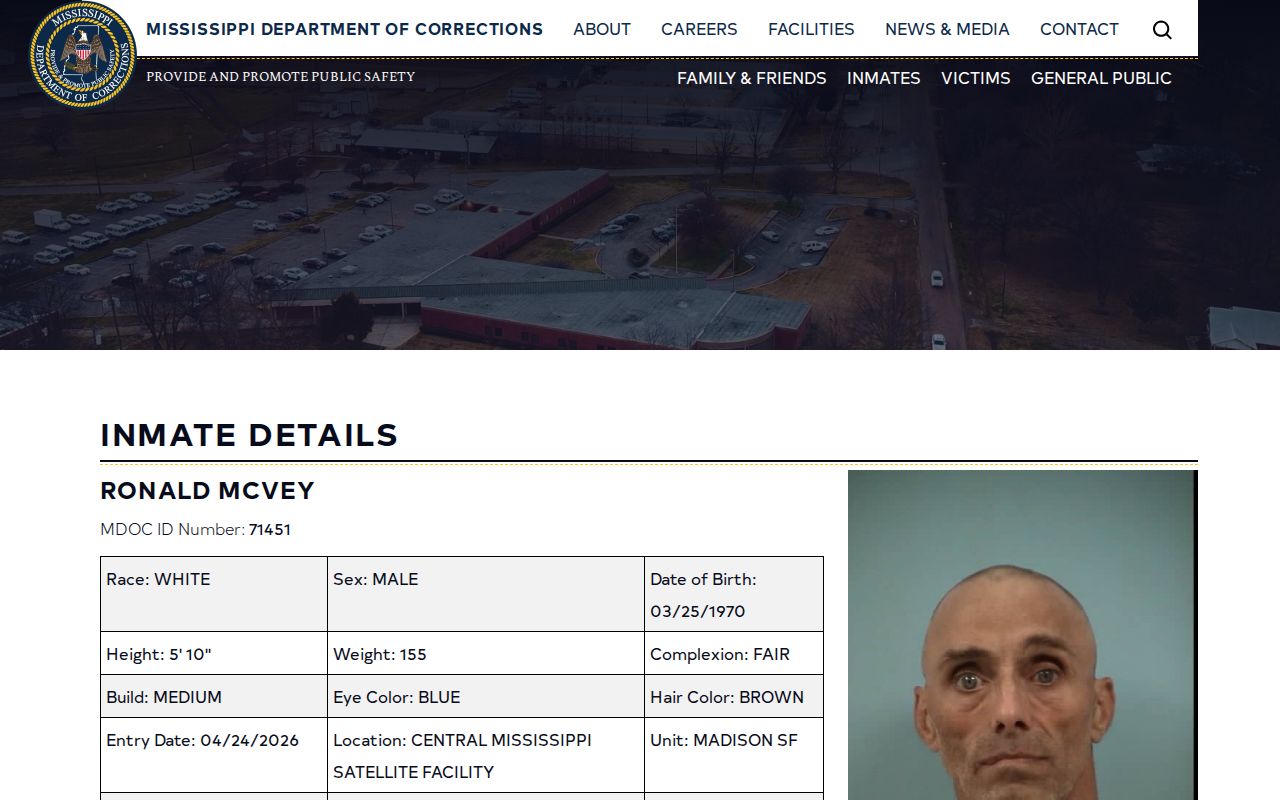
The image helps identify labels to read on a live result. A fresh person-specific search and MDOC confirmation remain necessary.
MDOC Actual Release Proof
MDOC’s official release guidance describes a process behind the public date. A case manager tells the inmate the expected date and asks about travel plans, which MDOC verifies. The public FAQ says this work can take 30 to 45 days and that the inmate must receive a discharge certificate before release. It also says MDOC may purchase in-state bus travel to the destination or nearest city when requested, but not out-of-state travel. These steps apply to MDOC release planning, not a county detainee bonding from WCCRCF.
Five events must remain separate: the public tentative date, statutory eligibility for parole or ERS, completion of release-plan review, issuance of the discharge certificate and physical release, and the start of any supervision. A person can reach an old projected date without leaving if another hold or unresolved prerequisite remains. An authorized release can also occur through a route that differs from an older projection.
- Tentative date
- MDOC’s current projected date, subject to change.
- Parole eligibility
- The earliest point the Board may consider release, not a promise.
- Discharge certificate
- Formal MDOC documentation required in the release process.
- Community supervision
- Legal oversight outside a facility under parole, ERS, probation, or another exact status.
MDOC Time Record Changes
MDOC computes parole, ERS, tentative discharge, and maximum release dates from the sentence and governing law. The starting record includes each count, whether terms run together or back to back, sentence dates, suspended portions, and lawful jail credit. MDOC’s handbook explains that eligible presentence jail credit helps establish the sentence-begin date. County time after an MDOC sentence is already incorporated rather than shown as a separate simple deduction.
Mississippi Code § 47-5-138 contains earned-time rules tied to sentence era and eligibility. For many post-June 30, 1995 sentences, its ordinary framework discusses 4.5 days for each 30 days served and a 15 percent cap, but exclusions, conduct, classification, sentence date, and other provisions matter. Section 47-5-139 excludes categories, and § 47-5-138.1 has a separate trusty-earned-time scheme. Parole eligibility under § 47-7-3 is another track. A flat “subtract 15 percent” calculation is unsound.
| Change | Possible effect |
|---|---|
| Corrected jail credit | Moves the sentence-begin or computed date |
| Amended sentence | Changes the legal term or count relationship |
| Earned-time loss or restoration | Alters eligible credit |
| New consecutive sentence | Extends total time |
| Detainer or hold | Can block community release or cause transfer |
| Parole action | Changes eligibility or supervision path |
Note: MDOC’s 85/15 example describes one framework; it is not a universal Mississippi release formula.
MDOC Records and Supervision
MDOC identifies its Records Department as the contact for offender time, jail credit, and eligibility-date questions. Written requests should supply the MDOC ID, date range, and exact record sought, such as the discharge record, time computation, or status record. Avoid a vague demand for every file. Sensitive, victim, medical, juvenile, security, and other exempt material can be withheld or redacted under applicable law.
MDOC Records Department
P.O. Box 24388
Jackson, MS 39225
Phone: (601) 933-2889
Email: MDOCRecordsDepartment@mdoc.state.ms.us
For parole status, MDOC directs questions to the Mississippi State Parole Board at 239 North Lamar Street, Suite 501, Jackson, MS 39202, phone (601) 576-3520, and MSStateParoleBoard@mdoc.state.ms.us. Community Corrections handles field supervision. The public Parolee Search can show MDOC ID, county, supervising officer, flat time date, and other returned fields. No equivalent public statewide probationer search or name-level absconder search was found.
MDOC WCCRCF Boundaries
WCCRCF’s state and county mission can blur labels. A county detainee may have no MDOC record even while housed in the same building as state prisoners. An MDOC prisoner may be transferred between state placements without any Winston County court release. Determine legal custodian before choosing a search. The state route requires the MDOC ID and sentence record; the county route requires the booking sheet and local court order.
VINELink can provide status notices from participating sources, but it is not the state master record or a complete historical docket. BOP and ICE have separate locators and should not be assumed to feed an MDOC record. If a source reports “released” while another still lists custody, preserve both timestamps and ask the agency that created the underlying event.
Note: Released, paroled, discharged, and transferred are distinct MDOC outcomes and should be recorded in the agency’s own words.
Preserve MDOC Release Proof
Record the search date, MDOC ID, location, status wording, tentative date, and the exact URL. The official WCCRCF page confirms the local state-and-county role, while the MDOC public-records channel is the state request route. Add the discharge certificate, Records response, or supervision entry that confirms what followed. A saved public result can document what the interface showed at one time, but the formal agency record controls when fields later change.